Tuesday, February 7, 2017
Hanna Blumenfeld
Hanna Blumenfeld, Hermann's niece, daughter of his twin sister was born on the 19th of February 1924 in Bad Mergentheim. Hanna was murdered, at the age of 17, together with her father, Rudolf Blumenfeld and mother, Rosa (Fechenbach) Blumenfeld at the Lithuanian death camp Fort IX near Kaunas (Kowno) on 25th November 1941.

Monday, January 30, 2017
New infromation on Hermann Fechenbach’s twin sister Rosel Fechenbach (Blumenfeld) and Family
I have uncover new information on Hermann Fechenbach’s twin sister Rosel Fechenbach and Family.
Rosel was married to Rudolf Blumenfeld (born 17th November 1880 in Creglingen / Mergentheim / Württemberg), Rudolf was imprisoned from 10th November 1938 to 19th December 1938 in Dachau concentration camp, while he and his family waiting in vain for permission to enter the United States.
Their daughter Hanna (born on 19th February 1924 in Bad Mergentheim) was imprisoned on 6th August 1941 at the small town of Unterschleißheim Bavaria, Germany, located about 17 km north of the city limits of Munich, at a forced labor camp (Flachsröste Lohhof).
On the 20th November 1941, Rudolf, Rosel and their daughter Hanna where deported from München (Munich) to Fort IX near Kaunas (Kowno), west of Vilna (Vilnius), Lithuania. Where on 25th November 1941 the entire family was murdered by Einsatzkommando 3 of Einsatzgruppe A (a mobile killing squad made up of SS and Gestapo, together with German police forces and Lithuanian auxiliaries).
See Notes for more information
Notes: Einsatzgruppen (German: special-ops units) were paramilitary groups originally formed in 1938 under the direction of Reinhard Heydrich – Chief of the SD, and Sicherheitspolizei (Security Police; SiPo). They were operated by the Schutzstaffel (SS). The first Einsatzgruppen of World War II were formed in the course of the 1939 invasion of Poland. Then following a Hitler-Himmler directive, the Einsatzgruppen were re-formed in anticipation of the 1941 invasion of the Soviet Union. The Einsatzgruppen were once again under the control of Reinhard Heydrich as Chief of the Reich Main Security Office (RSHA); and after his assassination, under the control of his successor, Ernst Kaltenbrunner.
The Einsatzkommando 3 of Einsatzgruppe A, was at that time commanded by Karl Jäger with a running total of their killings of 136,421 Jews (46,403 men 55,556 women, 34,464 children), 1,064 Communists, 653 mentally disabled, and 134 others, from 2 July-1 December 1941.
Rosel was married to Rudolf Blumenfeld (born 17th November 1880 in Creglingen / Mergentheim / Württemberg), Rudolf was imprisoned from 10th November 1938 to 19th December 1938 in Dachau concentration camp, while he and his family waiting in vain for permission to enter the United States.
Their daughter Hanna (born on 19th February 1924 in Bad Mergentheim) was imprisoned on 6th August 1941 at the small town of Unterschleißheim Bavaria, Germany, located about 17 km north of the city limits of Munich, at a forced labor camp (Flachsröste Lohhof).
On the 20th November 1941, Rudolf, Rosel and their daughter Hanna where deported from München (Munich) to Fort IX near Kaunas (Kowno), west of Vilna (Vilnius), Lithuania. Where on 25th November 1941 the entire family was murdered by Einsatzkommando 3 of Einsatzgruppe A (a mobile killing squad made up of SS and Gestapo, together with German police forces and Lithuanian auxiliaries).
See Notes for more information
Notes: Einsatzgruppen (German: special-ops units) were paramilitary groups originally formed in 1938 under the direction of Reinhard Heydrich – Chief of the SD, and Sicherheitspolizei (Security Police; SiPo). They were operated by the Schutzstaffel (SS). The first Einsatzgruppen of World War II were formed in the course of the 1939 invasion of Poland. Then following a Hitler-Himmler directive, the Einsatzgruppen were re-formed in anticipation of the 1941 invasion of the Soviet Union. The Einsatzgruppen were once again under the control of Reinhard Heydrich as Chief of the Reich Main Security Office (RSHA); and after his assassination, under the control of his successor, Ernst Kaltenbrunner.
The Einsatzkommando 3 of Einsatzgruppe A, was at that time commanded by Karl Jäger with a running total of their killings of 136,421 Jews (46,403 men 55,556 women, 34,464 children), 1,064 Communists, 653 mentally disabled, and 134 others, from 2 July-1 December 1941.
Friday, January 27, 2017
International Holocaust Remembrance Day
United Nations designated Jan. 27 as International Holocaust Remembrance Day, commemorating the date of the liberation of the Auschwitz death camp in 1945.


Photo i took some years back on a visit to Auschwitz, the first is the ovens used to burn the bodies.


Photo i took some years back on a visit to Auschwitz, the first is the ovens used to burn the bodies.
Friday, November 11, 2016
Night of Broken Glass
On the night of November 9, 1938, Kristallnacht (the "Night of Broken Glass”) in which violence against Jews broke out across Germany. German propaganda minister Joseph Goebbels and other Nazis had planned and organised the pogroms. In just two days, more than 250 synagogues were burned, Jewish businesses, schools and homes were trashed and looted, dozens of Jewish people were killed. After this many committed suicide while families tried desperately to leave.


Monday, October 24, 2016
100 years ago
On 26 October 1916 Hermann Fechenbach left for the front and joined the 413th regiment in the German Army (WWI).

Rosa Fechenbach born on this day
Rosa Fechenbach, born 24th October 1910 in Mergentheim, was deaf and dumb. She died in a concentration camp.
Tuesday, May 17, 2016
May 1945 Goebbles Murders Entire Family
1st of May 1945, Joseph Goebbles the German Propaganda Minister, murders his wife and six children before taking his own life on the same day as Berlin surrenders to the Soviet legions and the Western Allies.
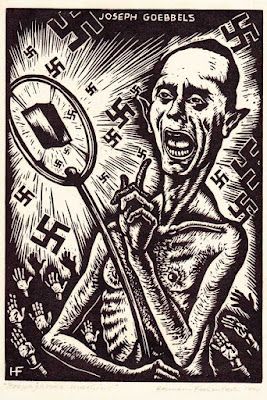 "Propaganda Machine" by Hermann Fechenbach
 "Propaganda Machine" by Hermann Fechenbach
Friday, April 15, 2016

Friday, November 13, 2015
Letter from Lydia K. Mansbach born Kahn, New Jersey, United States
Despite all the commercial difficulties for us Jews, which have increased noticeably in 1938, my father still went on business trips.
When the 8 November 1938 from Würzburg to Lauda drove the train home, he heard well into his compartment, that the Nazis Jews attacked and beaten. But in the meantime, our house was visited in Bad Mergentheim by an SS man who asked my mother where my father is, and she said that he has made a business trip, he was satisfied and left. My mother lost no time and went straight to the next train to Lauda, where they just encountered when transferring my father and told him, what had happened in Mergentheim. So they got out in Edelfin conditions and Moses went to our friend Frank, who hid my father for the night in a haystack. Until the following night, after everything was quiet again, my mother went with a friend to walk to Edelfingen and took my father home.
From my mother, both brothers Ludwig Jonas and wife Clare and Jacob Jonas and wife Martha were killed in concentration camps.
My father's brother Benno born Kahn with his wife Therese and daughter Marianne, who had already fled to Holland, have also been killed by the Hitler gangs.
It's so hard to remember, and I can not write about it.
When the 8 November 1938 from Würzburg to Lauda drove the train home, he heard well into his compartment, that the Nazis Jews attacked and beaten. But in the meantime, our house was visited in Bad Mergentheim by an SS man who asked my mother where my father is, and she said that he has made a business trip, he was satisfied and left. My mother lost no time and went straight to the next train to Lauda, where they just encountered when transferring my father and told him, what had happened in Mergentheim. So they got out in Edelfin conditions and Moses went to our friend Frank, who hid my father for the night in a haystack. Until the following night, after everything was quiet again, my mother went with a friend to walk to Edelfingen and took my father home.
From my mother, both brothers Ludwig Jonas and wife Clare and Jacob Jonas and wife Martha were killed in concentration camps.
My father's brother Benno born Kahn with his wife Therese and daughter Marianne, who had already fled to Holland, have also been killed by the Hitler gangs.
It's so hard to remember, and I can not write about it.
Letter from Jacob Fröhlich, Israel, 22 November 1964
The financially and emotionally very difficult years in our immigration in August 1938, all my powers have exhausted prematurely and undermine my earlier indestructible translucent health. What Hugo is concerned, unfortunately this kind brother has been snatched from over 9 years ago in the middle of full activity after a heart attack suddenly us. Hugo's daughter from his first marriage to Maya, Gizella Miriam, who had inherited the great grace and loveliness of her mother, has achieved a certain notoriety as Israel's first beauty queen. Our beloved mother Bertha born Neuhaus is in Theresienstadt on 29 Shevat 5703 died. My sister Sophie was killed with her husband and four children in Lodz, my sister Flora Weil, were rescued by the two daughters with her husband and other children in Izbica perished, and Rosel Eldod is, with her husband and four been shot very young children in Riga.
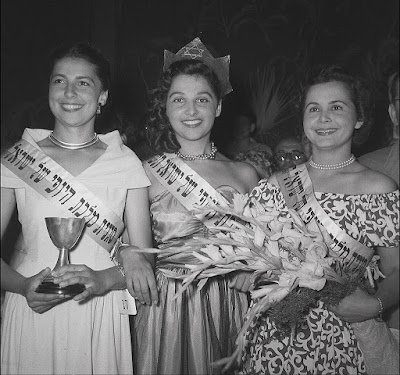
Miss Israel (Miriam Yaron [Jaross]) 1950 and her runner-ups

Miss Israel (Miriam Yaron [Jaross]) 1950 and her runner-ups
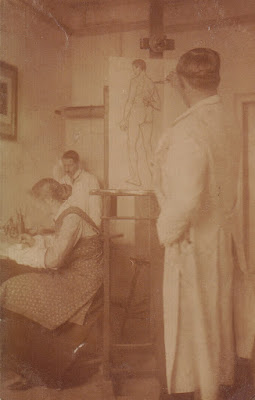
November 1918 Hermann starts drawing classes
After a leg amputation, as the result of a grenade explosion at the Battle of Passchendaele, which opened the way for Hermann Fechenbach to start his eagerly awaited artistic training. He took as a hospital inmate drawing classes at a school and visited the wounded in Stuttgart from November 1918 to the fall of 1921, the School of Applied Arts in Stuttgart (including Prof. P. Haustein). Then for two semesters studying at the Academy of Fine Arts in Stuttgart (Prof. R. Pötzelberger and Prof. C. Landsberger), which in 1922/23 at the Munich Academy of Art (Prof. Franz von Stuck).

Synagogue demolished November 1938
A first Mergentheimer synagogue was established in 1658, 1762, 1837 and 1912 respectively rebuilt and renewed. On 9h November 1938 demolished, but still survived the war years. After another renovation and consecration 1946 it was closed in 1957 and fell victim to the pickaxe.
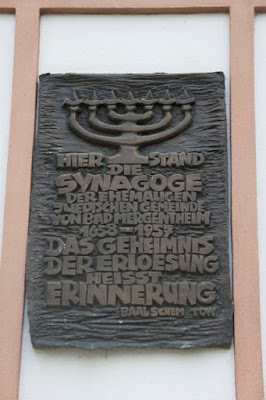
Current commemoration plaque of site of synagogue, Bad Mergentheim

Current commemoration plaque of site of synagogue, Bad Mergentheim
Letter from David Fröhlich about Kristallnacht, November 1938
David Fröhlich, Brooklyn, N.Y.,
My childhood memories, especially the last terrible years in Bad Mergentheim, I will never forget. Before Kristallnacht, November 8th-9th 1938, everything was bearable, although the Hitler Youth used every opportunity to harass us Jewish children. My father was very ill with a high fever, so that he could not meet their planned work. The Jewish doctor Dr. Hirnheimer was already in the Dachau concentration camp, and all the other doctors in Mergentheim were too timid and cowardly, to help the sick Jewish fellow citizens. My parents and we three children were completely without knowledge of what atrocities where to happened in the Kristallnacht, because we slept undisturbed exceptional that night. When I look back now, it was like a miracle that we were spared. The next day was a lot of shouting in the street, so we stayed at home scary, because we already felt that something terrible had happened, which was then also confirmed the radio.
The neighbor of our grandmother, Mrs. Stern-Herzog, who lived in the Holzapfelgasse, came to us and told us that they had destroyed all in the synagogue and school. Many of the Jewish men, especially those who were on the blacklist, had beaten half to death, including our honorable Rabbi Dr. Moses Kahn. Those who could still walk were arrested that morning and taken to prison, and transported to the concentration camp of Dachau. My father asked my mother that she should go into the Holzapfelgasse to check on the Fröhlich’s grandmother, and how had she survived everything, since they all lived near the synagogue. We moved into a terrible anxiety and fear, so that I fell helplessly and I hid in the kitchen on the ground and prayed. Suddenly there was silence again, and I heard that the policeman had left the house without my father, because he saw that the Nazi doctor Dr. Weiß (White) treated him as he was seriously ill in reality. So my father had the good fortune to be spared from all the raids. Nevertheless, we did not dare to go out on the streets, until we heard the next morning, that the action was over. In contrast, an order came from the mayor's office that the Jewish community had to put everything back in order, which the Nazis had broken and bruised. And we children were taken to the cleanup service, I could not understand that you can be so thoughtless and wildly smashed everything. All chandeliers and lamps, prayer books and Torah scrolls, benches and galleries, as well as all the windows were shattered one after the other in the synagogue. Even the holy ark was not spared, in which we found pork skin. At school the harmonium (musical instruments), and all benches were smashed, torn books and notebooks and all smeared with ink. It was a cruel and horrible sight. When the war broke out in August 1939, we were allowed to have only one hour a day for any purchases outside, but this provision was changed again. We were able leave Bad Mergentheim on 28 0f August 1939, but not until we felt free and safe, and on the 1st of October 1939 crossed the Dutch border. A rewarding feeling came over us that we have come out of this hell even with their lives.
Tuesday, July 21, 2015
Leo print by Hermann Fechenbach
Leo's ruler is the Sun at the centre of the Solar System and that is where Leo's see their place in the world. Leo's are a powerhouse of energy, and few star signs have the same level of drive and motivation. At the heart of this Leo energy is the fire element, which is recognisable in every aspect of Leo's life—work, love or play.

Special price on all Hermann Fechenbach sign of the Zodiac Posthumous Prints

Special price on all Hermann Fechenbach sign of the Zodiac Posthumous Prints
Monday, July 13, 2015
Gemini image from Hermann
Geminis are known as eternal students, always wanting to learn—and they don’t mind what the subject is. They are good at assembling a multitude of facts and then turning them into their next ’great idea’. However, they don’t always stay with this idea to the end, but it doesn’t concern them too much. What would concern them is not having the ‘great idea’ in the first place!
 ,
,
Special price on all Hermann Fechenbach sign of the Zodiac Posthumous Prints
 ,
,Special price on all Hermann Fechenbach sign of the Zodiac Posthumous Prints
Saturday, July 4, 2015
Lazarus Fechenbach died on 9th July 1903
Hermann’s Grandfather Lazarus Fechenbach died on 9th July 1903 at the age of 84. A crowd lined Mühlwehrstraße on both sides, people lined up several deep to pay their last respects to the departed. The funeral procession moved slowly through the town and stopped before the Tauber Bridge to speak a last farewell to the departed.

Photo of one end of Mühlwehrstraße 2015 Patrick Mooney

Photo of one end of Mühlwehrstraße 2015 Patrick Mooney
Sinking of the Arandora Star July 1940

The British Government was sending a relatively small number of aliens to the British Dominions, but when the tragedy on the 2 July, 1940 with the sinking of the liner Arandora Star by the German submarine U-47, the British Government had to re-think its policy of transferring aliens. the Arandora Star was taking 754 Italians and 479 Germans from Liverpool to St Johns, Newfoundland for internment, many of whom had either been briefly interned in the Isle of Man or had relatives interned on the Island. 486 Italians and 175 Germans were drowned. This ended the British Dominions being used for internment and instead concentrated on internment within the British Isles, and so the Isle of Man became one of the main interment camps.
Wednesday, May 6, 2015
May 1940 Hermann Fechenbach is interned in England
In May 1940 Hermann Fechenbach was interned in various camps and finally in the “Hutchinson Camp’ in Douglas on the Isle of Man, released in February 1941. It was while at the Hutchinson Camp that Hermann started “My impressions as a Refugee” as set of 21 linocuts as a record of the years of persecution in Germany under the Nazi party and his interment in England.

Hermann's Print "Interned" this is one of the most used of Hermann's images. It is of Bury and not of of the Isle of Man, but was cut while there, thus the confusion.

Hermann's Print "Interned" this is one of the most used of Hermann's images. It is of Bury and not of of the Isle of Man, but was cut while there, thus the confusion.
May 1903 Hermann starts school
May 1903 Hermann starts his first day at school in Bad Mergentheim. It was a Catholic primary school and Hermann was one of three jewish children in first class. It was here right from the start the Hermann’s drawing talents where recognised.

Print of children going to school in Bad Mergentheim by Hermann Fechenbach (from our the posthumous prints)

Print of children going to school in Bad Mergentheim by Hermann Fechenbach (from our the posthumous prints)
Tuesday, April 21, 2015
Some of the Fechenbach family born in April.
Noe, born 11th April 1859, in Würzburg, son of Lazarus and Jetta Fechenbach, married Rosalie Weikersheimer from Gaukttnigshofen. did three year's active military service in the cavalry. Later on he ran the bakery in Mergenthelm. Rosalie died in April 1935 and Noe on 24th November 1935. Both ill-fated parents were spared the further worry over their other sons. Moritz died on 24th December 1939 in Berlin. Max, the seriously disabled soldier, survived the concentration camp and Jacob, who was deaf and dumb, was murdered in the Sachsenhausen concentration camp in 1940.
Other April births include, Auguste, born 28th September 1862, married Samuel Ldffel and moved to Augsburg. Abraham, born 4th April 1865, was for years a gymnastic demonstrator and teacher in Mergentheim's gymnastics club. He served as a soldier for two years and settled down as a baker in Mergenthelm. Therese, born 14th April 1867, married Morltz Ettlinger and moved to Karlsruhe.
Subscribe to:
Posts (Atom)