 "Propaganda Machine" by Hermann Fechenbach
Tuesday, May 17, 2016
May 1945 Goebbles Murders Entire Family
1st of May 1945, Joseph Goebbles the German Propaganda Minister, murders his wife and six children before taking his own life on the same day as Berlin surrenders to the Soviet legions and the Western Allies.
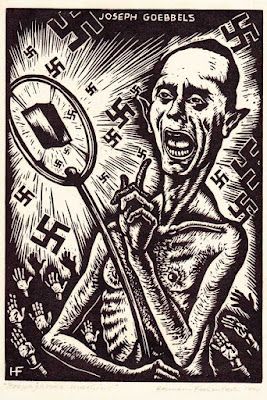 "Propaganda Machine" by Hermann Fechenbach
"Propaganda Machine" by Hermann Fechenbach

Friday, April 15, 2016

Friday, November 13, 2015
Letter from Lydia K. Mansbach born Kahn, New Jersey, United States
Despite all the commercial difficulties for us Jews, which have increased noticeably in 1938, my father still went on business trips.
When the 8 November 1938 from Würzburg to Lauda drove the train home, he heard well into his compartment, that the Nazis Jews attacked and beaten. But in the meantime, our house was visited in Bad Mergentheim by an SS man who asked my mother where my father is, and she said that he has made a business trip, he was satisfied and left. My mother lost no time and went straight to the next train to Lauda, where they just encountered when transferring my father and told him, what had happened in Mergentheim. So they got out in Edelfin conditions and Moses went to our friend Frank, who hid my father for the night in a haystack. Until the following night, after everything was quiet again, my mother went with a friend to walk to Edelfingen and took my father home.
From my mother, both brothers Ludwig Jonas and wife Clare and Jacob Jonas and wife Martha were killed in concentration camps.
My father's brother Benno born Kahn with his wife Therese and daughter Marianne, who had already fled to Holland, have also been killed by the Hitler gangs.
It's so hard to remember, and I can not write about it.
When the 8 November 1938 from Würzburg to Lauda drove the train home, he heard well into his compartment, that the Nazis Jews attacked and beaten. But in the meantime, our house was visited in Bad Mergentheim by an SS man who asked my mother where my father is, and she said that he has made a business trip, he was satisfied and left. My mother lost no time and went straight to the next train to Lauda, where they just encountered when transferring my father and told him, what had happened in Mergentheim. So they got out in Edelfin conditions and Moses went to our friend Frank, who hid my father for the night in a haystack. Until the following night, after everything was quiet again, my mother went with a friend to walk to Edelfingen and took my father home.
From my mother, both brothers Ludwig Jonas and wife Clare and Jacob Jonas and wife Martha were killed in concentration camps.
My father's brother Benno born Kahn with his wife Therese and daughter Marianne, who had already fled to Holland, have also been killed by the Hitler gangs.
It's so hard to remember, and I can not write about it.
Letter from Jacob Fröhlich, Israel, 22 November 1964
The financially and emotionally very difficult years in our immigration in August 1938, all my powers have exhausted prematurely and undermine my earlier indestructible translucent health. What Hugo is concerned, unfortunately this kind brother has been snatched from over 9 years ago in the middle of full activity after a heart attack suddenly us. Hugo's daughter from his first marriage to Maya, Gizella Miriam, who had inherited the great grace and loveliness of her mother, has achieved a certain notoriety as Israel's first beauty queen. Our beloved mother Bertha born Neuhaus is in Theresienstadt on 29 Shevat 5703 died. My sister Sophie was killed with her husband and four children in Lodz, my sister Flora Weil, were rescued by the two daughters with her husband and other children in Izbica perished, and Rosel Eldod is, with her husband and four been shot very young children in Riga.
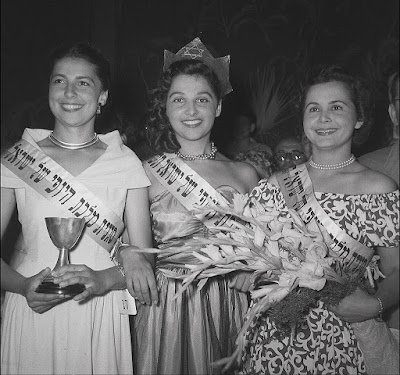
Miss Israel (Miriam Yaron [Jaross]) 1950 and her runner-ups

Miss Israel (Miriam Yaron [Jaross]) 1950 and her runner-ups
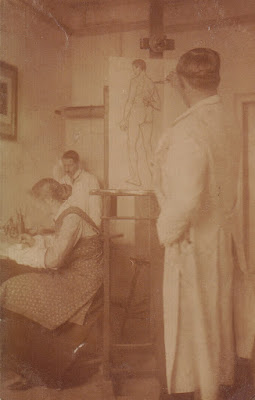
November 1918 Hermann starts drawing classes
After a leg amputation, as the result of a grenade explosion at the Battle of Passchendaele, which opened the way for Hermann Fechenbach to start his eagerly awaited artistic training. He took as a hospital inmate drawing classes at a school and visited the wounded in Stuttgart from November 1918 to the fall of 1921, the School of Applied Arts in Stuttgart (including Prof. P. Haustein). Then for two semesters studying at the Academy of Fine Arts in Stuttgart (Prof. R. Pötzelberger and Prof. C. Landsberger), which in 1922/23 at the Munich Academy of Art (Prof. Franz von Stuck).

Synagogue demolished November 1938
A first Mergentheimer synagogue was established in 1658, 1762, 1837 and 1912 respectively rebuilt and renewed. On 9h November 1938 demolished, but still survived the war years. After another renovation and consecration 1946 it was closed in 1957 and fell victim to the pickaxe.
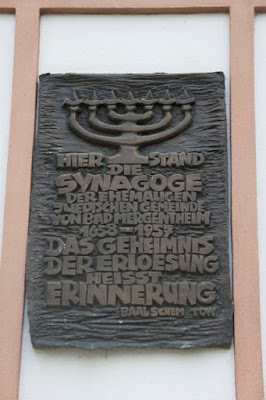
Current commemoration plaque of site of synagogue, Bad Mergentheim

Current commemoration plaque of site of synagogue, Bad Mergentheim
Letter from David Fröhlich about Kristallnacht, November 1938
David Fröhlich, Brooklyn, N.Y.,
My childhood memories, especially the last terrible years in Bad Mergentheim, I will never forget. Before Kristallnacht, November 8th-9th 1938, everything was bearable, although the Hitler Youth used every opportunity to harass us Jewish children. My father was very ill with a high fever, so that he could not meet their planned work. The Jewish doctor Dr. Hirnheimer was already in the Dachau concentration camp, and all the other doctors in Mergentheim were too timid and cowardly, to help the sick Jewish fellow citizens. My parents and we three children were completely without knowledge of what atrocities where to happened in the Kristallnacht, because we slept undisturbed exceptional that night. When I look back now, it was like a miracle that we were spared. The next day was a lot of shouting in the street, so we stayed at home scary, because we already felt that something terrible had happened, which was then also confirmed the radio.
The neighbor of our grandmother, Mrs. Stern-Herzog, who lived in the Holzapfelgasse, came to us and told us that they had destroyed all in the synagogue and school. Many of the Jewish men, especially those who were on the blacklist, had beaten half to death, including our honorable Rabbi Dr. Moses Kahn. Those who could still walk were arrested that morning and taken to prison, and transported to the concentration camp of Dachau. My father asked my mother that she should go into the Holzapfelgasse to check on the Fröhlich’s grandmother, and how had she survived everything, since they all lived near the synagogue. We moved into a terrible anxiety and fear, so that I fell helplessly and I hid in the kitchen on the ground and prayed. Suddenly there was silence again, and I heard that the policeman had left the house without my father, because he saw that the Nazi doctor Dr. Weiß (White) treated him as he was seriously ill in reality. So my father had the good fortune to be spared from all the raids. Nevertheless, we did not dare to go out on the streets, until we heard the next morning, that the action was over. In contrast, an order came from the mayor's office that the Jewish community had to put everything back in order, which the Nazis had broken and bruised. And we children were taken to the cleanup service, I could not understand that you can be so thoughtless and wildly smashed everything. All chandeliers and lamps, prayer books and Torah scrolls, benches and galleries, as well as all the windows were shattered one after the other in the synagogue. Even the holy ark was not spared, in which we found pork skin. At school the harmonium (musical instruments), and all benches were smashed, torn books and notebooks and all smeared with ink. It was a cruel and horrible sight. When the war broke out in August 1939, we were allowed to have only one hour a day for any purchases outside, but this provision was changed again. We were able leave Bad Mergentheim on 28 0f August 1939, but not until we felt free and safe, and on the 1st of October 1939 crossed the Dutch border. A rewarding feeling came over us that we have come out of this hell even with their lives.
Tuesday, July 21, 2015
Leo print by Hermann Fechenbach
Leo's ruler is the Sun at the centre of the Solar System and that is where Leo's see their place in the world. Leo's are a powerhouse of energy, and few star signs have the same level of drive and motivation. At the heart of this Leo energy is the fire element, which is recognisable in every aspect of Leo's life—work, love or play.

Special price on all Hermann Fechenbach sign of the Zodiac Posthumous Prints

Special price on all Hermann Fechenbach sign of the Zodiac Posthumous Prints
Monday, July 13, 2015
Gemini image from Hermann
Geminis are known as eternal students, always wanting to learn—and they don’t mind what the subject is. They are good at assembling a multitude of facts and then turning them into their next ’great idea’. However, they don’t always stay with this idea to the end, but it doesn’t concern them too much. What would concern them is not having the ‘great idea’ in the first place!
 ,
,
Special price on all Hermann Fechenbach sign of the Zodiac Posthumous Prints
 ,
,Special price on all Hermann Fechenbach sign of the Zodiac Posthumous Prints
Saturday, July 4, 2015
Lazarus Fechenbach died on 9th July 1903
Hermann’s Grandfather Lazarus Fechenbach died on 9th July 1903 at the age of 84. A crowd lined Mühlwehrstraße on both sides, people lined up several deep to pay their last respects to the departed. The funeral procession moved slowly through the town and stopped before the Tauber Bridge to speak a last farewell to the departed.

Photo of one end of Mühlwehrstraße 2015 Patrick Mooney

Photo of one end of Mühlwehrstraße 2015 Patrick Mooney
Sinking of the Arandora Star July 1940

The British Government was sending a relatively small number of aliens to the British Dominions, but when the tragedy on the 2 July, 1940 with the sinking of the liner Arandora Star by the German submarine U-47, the British Government had to re-think its policy of transferring aliens. the Arandora Star was taking 754 Italians and 479 Germans from Liverpool to St Johns, Newfoundland for internment, many of whom had either been briefly interned in the Isle of Man or had relatives interned on the Island. 486 Italians and 175 Germans were drowned. This ended the British Dominions being used for internment and instead concentrated on internment within the British Isles, and so the Isle of Man became one of the main interment camps.
Wednesday, May 6, 2015
May 1940 Hermann Fechenbach is interned in England
In May 1940 Hermann Fechenbach was interned in various camps and finally in the “Hutchinson Camp’ in Douglas on the Isle of Man, released in February 1941. It was while at the Hutchinson Camp that Hermann started “My impressions as a Refugee” as set of 21 linocuts as a record of the years of persecution in Germany under the Nazi party and his interment in England.

Hermann's Print "Interned" this is one of the most used of Hermann's images. It is of Bury and not of of the Isle of Man, but was cut while there, thus the confusion.

Hermann's Print "Interned" this is one of the most used of Hermann's images. It is of Bury and not of of the Isle of Man, but was cut while there, thus the confusion.
May 1903 Hermann starts school
May 1903 Hermann starts his first day at school in Bad Mergentheim. It was a Catholic primary school and Hermann was one of three jewish children in first class. It was here right from the start the Hermann’s drawing talents where recognised.

Print of children going to school in Bad Mergentheim by Hermann Fechenbach (from our the posthumous prints)

Print of children going to school in Bad Mergentheim by Hermann Fechenbach (from our the posthumous prints)
Tuesday, April 21, 2015
Some of the Fechenbach family born in April.
Noe, born 11th April 1859, in Würzburg, son of Lazarus and Jetta Fechenbach, married Rosalie Weikersheimer from Gaukttnigshofen. did three year's active military service in the cavalry. Later on he ran the bakery in Mergenthelm. Rosalie died in April 1935 and Noe on 24th November 1935. Both ill-fated parents were spared the further worry over their other sons. Moritz died on 24th December 1939 in Berlin. Max, the seriously disabled soldier, survived the concentration camp and Jacob, who was deaf and dumb, was murdered in the Sachsenhausen concentration camp in 1940.
Other April births include, Auguste, born 28th September 1862, married Samuel Ldffel and moved to Augsburg. Abraham, born 4th April 1865, was for years a gymnastic demonstrator and teacher in Mergentheim's gymnastics club. He served as a soldier for two years and settled down as a baker in Mergenthelm. Therese, born 14th April 1867, married Morltz Ettlinger and moved to Karlsruhe.
Buy Only German April 1933
The boycott of Jews was called for Saturday 1st April 1933. It was represented as a defensive action against the Jewish pests among the population, who, according to the government, were conducting a gruesome propaganda war against Germany.


April 1910 Hermann leaves school to start his apprenticeship
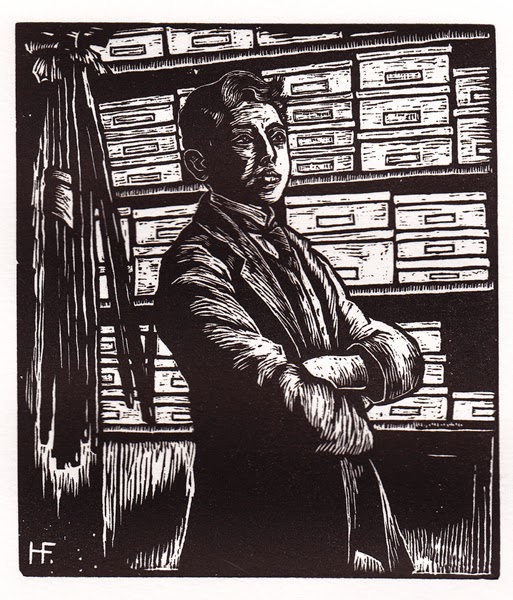
Hermann Fechenbach was allowed to leave school on 1st April 1910 to take up his first apprentice position. His father's parting words where, "Whoever does not hold out through his apprentice time will be a failure all his life".

Wednesday, March 25, 2015
Arts Review, 1 March 1985
Arts Review
1 March 1985 Volume XXXVII No 4
Guy Burn writes about Hermann Fechenbach at the Blond Fine Art Gallery
Blond Fine Art has at last found a suitably spacious new gallery in Princes Street, the lease at Sackville Street having ended. His first print show is a one man exhibition, a discovery of long hidden talent. Herman Fechenbach is now eighty eight years old, and has had a long frustrating career as a wood engraver and linocutter. The abundant work forms in a way a diary of his sadly disrupted life, where success and fulfillment have evaded his grasp by force of circumstances. His early work in his home town of Bad Mergentheim shows great promise; fairy stories and Jewish life are portrayed. But the loss of a leg in the 1914-18 war was a cruel setback, with years of convalescence. His illustrations for the Hagadah and the plague won him recognition in Germany, only to be snatched away by the advent of the Nazis. Caricatures of Himmler, Goebbels etc., are redolent of hatred. The Children's Train is an emotional record of the long line of trucks on its way to Belsen, crammed with French children who spill out on to the tracks.
He was forced to flee to Israel, and some constructive work was done, notably Call to Lunch showing a Kibbutz girl beating a large iron ring. But Israel did not suit him and he emigrated to England in 1939. Hardly settled here, he was summarily interned in 1940, eventually arriving in the Isle of Man. His delicate wood engravings were no longer feasible and from then on lino was the only medium obtainable. Arrested, Police Station, and Interned are disturbing records of unhappiness in hostile surroundings. The Isle of Man series involving intricate interweaving patterns of barbed wire with the sun shining hopefully through, record a happier time. He starts to use colour blocks: there are blue birds flying in a blue sky, Release found him looking for subjects rather than being dominated by them. His lyrical nudes and peaceful subjects like children in the playground, are brave attempts to grasp normality.

Police Station By Hermann Fechenbach
1 March 1985 Volume XXXVII No 4
Guy Burn writes about Hermann Fechenbach at the Blond Fine Art Gallery
Blond Fine Art has at last found a suitably spacious new gallery in Princes Street, the lease at Sackville Street having ended. His first print show is a one man exhibition, a discovery of long hidden talent. Herman Fechenbach is now eighty eight years old, and has had a long frustrating career as a wood engraver and linocutter. The abundant work forms in a way a diary of his sadly disrupted life, where success and fulfillment have evaded his grasp by force of circumstances. His early work in his home town of Bad Mergentheim shows great promise; fairy stories and Jewish life are portrayed. But the loss of a leg in the 1914-18 war was a cruel setback, with years of convalescence. His illustrations for the Hagadah and the plague won him recognition in Germany, only to be snatched away by the advent of the Nazis. Caricatures of Himmler, Goebbels etc., are redolent of hatred. The Children's Train is an emotional record of the long line of trucks on its way to Belsen, crammed with French children who spill out on to the tracks.
He was forced to flee to Israel, and some constructive work was done, notably Call to Lunch showing a Kibbutz girl beating a large iron ring. But Israel did not suit him and he emigrated to England in 1939. Hardly settled here, he was summarily interned in 1940, eventually arriving in the Isle of Man. His delicate wood engravings were no longer feasible and from then on lino was the only medium obtainable. Arrested, Police Station, and Interned are disturbing records of unhappiness in hostile surroundings. The Isle of Man series involving intricate interweaving patterns of barbed wire with the sun shining hopefully through, record a happier time. He starts to use colour blocks: there are blue birds flying in a blue sky, Release found him looking for subjects rather than being dominated by them. His lyrical nudes and peaceful subjects like children in the playground, are brave attempts to grasp normality.

Police Station By Hermann Fechenbach
Monday, March 16, 2015
Felix Fechenbach Jailed 11th March 1933
On 11 March 1933 Felix Fechenbach, Hermann's cousin, was jailed by the new Nazi government for his anti-fascist activities, and was shot on 7 August by members of the SS and SA in a forest between Detmold and Warburg while being transported to the Dachau concentration camp.


Wednesday, March 11, 2015
Letter form Getta Kellermann born Fröhlich, Israel, on 16 March 1965
Dear Mr. Fechenbach,,
First, I must introduce myself. I am the youngest of the twelve Fröhlich children from Bad Mergentheim. You will not be able to remember me as I was born when we have to "thank the German fatherland for the certainty of war,"-
During a visit with my brother Jacob the request came as a war party to the First World War on your work, a to write book about the last Mergentheimer Jews, and your request, if possible, to contribute material to this topic After reading about Italy until 1940 (the last legal time before declaring war between Italy and England). Many student with certificate emigrated from Mergentheim, there are few things I still remember from that time on.
We sold all our belongings in 1939 and after living in Germany could no longer live as Jew (the Nuremberg Laws), my dear mother and I, we are looking for accommodation we found a room at Miss Westheimer (Ochsengasse or Wettgrass next to City Hall). I admire today, as then, my almost 70 year old mother in a barely heated room (no one dared for us to repair the old stove, and it was a bitterly cold winter) and to get used to the primitive sanitary facilities. (She had probably used later on far worse.) Our "march" on the Holzapfelgrasse we taken with Jacob Fisch, who had tried shortly before to commit suicide by taking a large dose of sleeping pills but was rescued by hospital treatment. Cynical, mocking laughter accompanied our kids wagon march with all the things-most. Miss Miltenberg woman who had sold the Fechenbach Inn to a greengrocer, had shortly before accounted that she had just found Miss Sara Rothschild shot on Holzapfelgrasse.
We held our last small simple service of worship of Jom Kippur and Rosch Haschonoh – in a very depressed mood after the evil which had either destroyed or closed the synagogues in Germany.
When the food cards where tossed around I was never been accosted and even got an extra ration of eggs instead of meat ration even for my suffering mother. A farmer's daughter Rüdenauer (former neighbors) at night had secretly brought my mother some necessary food, even then a dangerous proposition.
When I emigrated in 1940 (with only hand luggage), I had brought my mother to Nüremberg with the best hope that soon my good mother would get, as her parents had applied for, a certificate to English for my mother and my siblings. The possibility of inhumane deportations would then, in 1940, no one would have believed. Maybe you can from Mrs. Carlé (drugstore at the Town Hall), which until recently had a friendly relationship with his wife Annette Rothschild, learn about the last Mergentheim Jews. Perhaps the butcher Adam Lochner (Hozapfelgrasse) may have seen a large part the last events of the Jewish community in Mergentheimer.
Perhaps some of this above material is suitable for your work.
Sincerely yours
Getta Kellermann
born Fröhlich

First, I must introduce myself. I am the youngest of the twelve Fröhlich children from Bad Mergentheim. You will not be able to remember me as I was born when we have to "thank the German fatherland for the certainty of war,"-
During a visit with my brother Jacob the request came as a war party to the First World War on your work, a to write book about the last Mergentheimer Jews, and your request, if possible, to contribute material to this topic After reading about Italy until 1940 (the last legal time before declaring war between Italy and England). Many student with certificate emigrated from Mergentheim, there are few things I still remember from that time on.
We sold all our belongings in 1939 and after living in Germany could no longer live as Jew (the Nuremberg Laws), my dear mother and I, we are looking for accommodation we found a room at Miss Westheimer (Ochsengasse or Wettgrass next to City Hall). I admire today, as then, my almost 70 year old mother in a barely heated room (no one dared for us to repair the old stove, and it was a bitterly cold winter) and to get used to the primitive sanitary facilities. (She had probably used later on far worse.) Our "march" on the Holzapfelgrasse we taken with Jacob Fisch, who had tried shortly before to commit suicide by taking a large dose of sleeping pills but was rescued by hospital treatment. Cynical, mocking laughter accompanied our kids wagon march with all the things-most. Miss Miltenberg woman who had sold the Fechenbach Inn to a greengrocer, had shortly before accounted that she had just found Miss Sara Rothschild shot on Holzapfelgrasse.
We held our last small simple service of worship of Jom Kippur and Rosch Haschonoh – in a very depressed mood after the evil which had either destroyed or closed the synagogues in Germany.
When the food cards where tossed around I was never been accosted and even got an extra ration of eggs instead of meat ration even for my suffering mother. A farmer's daughter Rüdenauer (former neighbors) at night had secretly brought my mother some necessary food, even then a dangerous proposition.
When I emigrated in 1940 (with only hand luggage), I had brought my mother to Nüremberg with the best hope that soon my good mother would get, as her parents had applied for, a certificate to English for my mother and my siblings. The possibility of inhumane deportations would then, in 1940, no one would have believed. Maybe you can from Mrs. Carlé (drugstore at the Town Hall), which until recently had a friendly relationship with his wife Annette Rothschild, learn about the last Mergentheim Jews. Perhaps the butcher Adam Lochner (Hozapfelgrasse) may have seen a large part the last events of the Jewish community in Mergentheimer.
Perhaps some of this above material is suitable for your work.
Sincerely yours
Getta Kellermann
born Fröhlich

March 1933 Hitler Comes to Power

Hermann Fechenbach wrote.
"On 5th March 1933, as the result of demoralization of the majority of the population, Hitler came to power in Germany. I had to ask myself where was the remnant of the influence of our greatest Germans - Goethe, Schiller, Beethoven?
Within myself I heard the melody always sounding:
Joy, beautiful divine spark,
Daughter of Elysium,
Dazzled with fire we greet
Your holiness
Your magic ties together,
Once again what fashion has unbound.
All men will be brothers,
Where your gentle wings remain.
You embrace millions.
This kiss for the world entire.
Brothers! Over the starry tent
The great Father must dwell.
I had to work on a woodcut of Beethoven's head the whole night through, so that I would not forget that there was still a true German spark alive somewhere.

Image from Penelope Smith, thank you.
Tuesday, February 17, 2015
Haifa 1938
This is one of Greta's photographs taken between February and May 1938, it shows the city of Haifa in northern Israel (then Palestine). After the Declaration of the Establishment of the State of Israel on 14 May 1948, Haifa became the gateway for Jewish immigration into Israel.

To see more of Greta photography visit: http://www.hermannfechenbach.com/greta_photos1.html

To see more of Greta photography visit: http://www.hermannfechenbach.com/greta_photos1.html
Monday, February 2, 2015
February 1983 Hermann Fechenbach marries Mary Burne
February 1983 Hermann Fechenbach, now at least 87 years old,marries his housekeeper and secretary, the Irishwoman Mary Burne.


Palestine 1938
Hermann Fechenbach wrote of his hopes to move to Palestine, "My wife and I also had certain plans to emigrate, and had already registered to go to Palestine in 1936. Since I was a 70% disabled war veteran and also could not raise the necessary capital funds, I continued to wait in hope for my certificate to arrive. Even a three month trip in February 1938 to Palestine could not accelerate the emigration process, although everyone appeared ready to help out and gave us the good advice simply to remain illegally in Palestine.
Since we had too many responsibilities to leave behind, we returned home in the middle of May. On the ship we made the acquaintance of an English Quaker lady, who gave us her address so that we could call on her in any emergency for help when required."

This chance meeting on their return to Germany was to prove a lucky one as it paved the way for Greta, and later Hermann, to escape to England.

One of the many photos taken by Greta (February to May 1938)
February 1941
Hermann Fechenbach from May 1940 to February 1941 was one of many emigrant, known as "enemy alien", interned in various camps. His final interment was in the "Hutchinson Camp", Douglas on the Isle of Man, at least wife Greta was housed nearby during this period.


Tuesday, January 20, 2015
Birth of Marie Helene Margarethe Batzke (Greta)
Born on this day 20th February 1894, Marie Helene Margarethe Batzke, know as Greta, in Straiipitz. She was not Jewish but Evangelical (Protestant). She became Hermann’s second wife in 1930, she was a professional photographer, his first marriage was a rash and unhappy one to Luba Lowinski in January 1926, they divorced in April 1928, a Jew, and as far as I can work out was from a Zionist background, but I have no other real information. If anyone reading this has any information, photographs etc. to add it would be of great interest in building a more complete picture.


Photo of Marie Helene Margarethe Batzke (Greta)
Monday, January 19, 2015
1936 prohibited from exhibiting
In January 1936 because of being Jewish Hermann Fechenbach, along with all other Jews, where prohibited from exhibiting in public buildings and excluded from the "Reich Chamber of Fine Arts".


Hermann Fechenbach painting in 1937.
Wednesday, January 14, 2015
Remembering Dr. Kahn who died 2nd January 1946
During the so-called "crystal night”, 8th November 1938, a victorious NAZI mob broke into Max Kahn's house, where they cut off the beard of the widely respected Rabbi, Dr. Moses Kahn, harshly maltreated him and threw him down the staircase. Dr. Kahn with his wife emigration to Palestine in August 1939, where he died on the 2nd January 1946 in extremely poor conditions.


Wednesday, January 7, 2015
January 11, 1897, birth of Hermann and Rosel Fechenbach
On the night of the 11th January 1897 Hermann Fechenbach was born shortly after his twin sister Rosa ("Rosel"), the third child of the Jewish couple M. Max and Sophie Fechenbach, born at Gänsmarkt 8 in Bad Mergentheim, Germany.


Thursday, December 4, 2014
Greta (Margarethe Batzke) gets papers to leave
Greta (Marie Helene Margarethe Batzke), Hermann Fechenbach's wife, gets her papers on December 4th 1938 so she can travel to England and escape Nazi persecution due to her marriage to a Jew. Greta who was a photographer lost all her camera and studio equipment which disappeared during shipment from Germany.


Greta and Hermann
Monday, November 17, 2014
Hutchinson Internment Camp exhibition November 1940
In November 1940 Captain Hubert Daniel who was the Commander in charge of the Hutchinson Internment Camp in Douglas, Isle of Man, opened an exhibition of work by the artists interned there. Artists included Paul Hamann, Kurt Schwitters, Fritz Kraemer, Georg Ehrlich, Siegfried Charoux, Fritz Solomonski, Fred Uhlman, Carlo Pietzner, Erich Kahn, Ernst M. Blcnsdorf, Hellmuth Weissenborn and Hugo 'Puck' Dachinger (the inventor of patented adhesive lettering system “Letraset”).
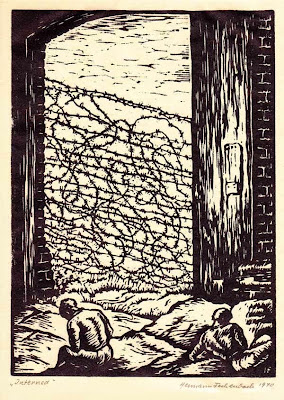
Captain Hubert Daniel contributed to the tangible heritage of the Hutchinson Camp as he kept a photographic record of the artists work, one of which is ‘Interned’ a linocut by Hermann Fechenbach.
The image 'Interned' is mistakenly seen as the Isle of Man, while it was cut there in 1940 it is not of the Isle of Man, but of a disused factory that was converted into a prison in Bury. This was before Hermann was sent on to Liverpool prison and finally on to the Hutchinson Camp.

Monday, November 10, 2014
Recent email error
Hi,
Due to an error any recent emails have accidentally been delated. If you have email in the last few days and have gotten no reply please re-email.
Regards
Pat Mooney
Monday, November 3, 2014
Synagogue at Bad Mergentheim & Dr. Moses Kahn
During the events of November 9th and 10th, 1938 called the “Kristallnacht” or “Night of Broken Glass” the Nazis destroyed almost all Jewish synagogues in Germany. The only synagogue believed to have escaped the destroying rage of the Nazis is at Bad Mergentheim, in southern Germany, Hermann Fechenbach’s family home town. The Bad Mergentheim synagogue was shut down on the 9th of November, 1939, it was not burned down for fear that the fire would destroy the other building attached to it. Also on that night the very respected rabbi Dr. Moses Kahn, then 67 years old, was almost beaten to death by the Nazi SA at his home.


Wednesday, October 29, 2014
Hermann finally gets to Art College
It took the lose of Hermann's leg during World War 1 for his parents to let him finally go to art college. From November 1918 to the fall of 1921, Hermann Fechenbach attended the School of Applied Arts in Stuttgart.


Tuesday, October 28, 2014
October 1926
In October 1926, Hermann Fechenbach moves into his new small house, in the Württemberg district.

Pictured here is Hermann gardening outside his house.

Thursday, October 23, 2014
Eastman Kodak No. 2 Camera
This photograph is most likely taken by a Kadak No.2 Camera which wehre masked to a round image. It was advertised that this was to avoid the necessity of holding the camera level but a more important consideration must have been the fact that the lens used did not have an image that was sharp to the edges. The photographs were mounted on buff or dark brown cards.


Wednesday, October 22, 2014
Thirty-two years ago tomorrow
Thirty-two years ago tomorrow on 23th October 1982, Margarethe (Greta) Fechenbach died after a long illness. On leaving Germany in December 1939 Greta abandoned her career as a photographer to set up a new life for herself and Hermann in England.


Saturday, June 28, 2014
28th of June 1914 the event that triggered WW1
On this day one hundred years ago the double assassination of Archduke Franz Ferdinand and his wife Sophie, shot by the nineteen-year-old Gavrilo Princip on in Sarajevo's Franz Josef Strasse. This event has gone down in history as the incident that triggered the First World War.

Below, I believe is a photo of M Max Fechenbach, Hermann’s father, in uniform. Hermann, his father, his brother Siegfried and cousin Julius all fought in World War One.

Thursday, June 12, 2014
Your Ocean Blue Eyes, Song June 1949
Song written 65 years ago, dated June 1949 called “Your Ocean Blue Eyes” by Margarethe (Greta Batzke) Fechenbach. Also a wonderful photograph of Hermann and Grete, taken by Grete in she studio in Stuttgart before they had to flee Nazi Germany in 1939.
and deep are the skies
but how deep, how deep
are your ocean blue eyes.
Ahoi, ahoi, ahoi.
and fly into skies
for a smile, a smile
of your ocean blue eyes.
Ahoi, ahoi, ahoi.
and conquered the skies
but I drown, I drown
in your ocean blue eyes.
Ahoi, ahoi, ahoi.
and forsake the skies
will love till I die
your ocean blue eyes.
Ahoi, ahoi, ahoi.
Your Ocean Blue Eyes
Deep are the seas
and deep are the skies
but how deep, how deep
are your ocean blue eyes.
Ahoi, ahoi, ahoi.
Will dive into seas
and fly into skies
for a smile, a smile
of your ocean blue eyes.
Ahoi, ahoi, ahoi.
I have sailed the seas
and conquered the skies
but I drown, I drown
in your ocean blue eyes.
Ahoi, ahoi, ahoi.
Will leave the seas
and forsake the skies
will love till I die
your ocean blue eyes.
Ahoi, ahoi, ahoi.

You can see the reflection of Hermann and Grete, also the camera to the right.
One Word from You by Grete Batzke

It strange to feel that I have become the guardian of the writings of Margarethe (Greta Batzke) Fechenbach. I will have to make a complete part of the www.hermannfechenbach.com dedicated to Grete’s work.
Here is a song from the archive that has been placed in my care, it’s called ‘One Word From You’ and dated August 1949.
One Word From You.
One word from you
that will work wonder
one word from you
that will go far
will make the roses blush
in pride and wonder
one word from you
will light the
newborn star.
My darling say it
do not delay it
the Sweetest word.
I am so lonely
you are my only
affinity.
Sweetheart I love you
do make my dream come true
our dream come true.
One word from you
that will work wonder
one word from you
that will go far
will make the roses blush
in pride and wonder
one word from you
will light the
newborn star.
Wednesday, June 11, 2014
Poem 'Hagadja' by Margarethe (Greta Batzke) Fechenbach dated 1947
Hagadja.
my father bought
of a jolly heart
and a snow white coat
at man and maker
bloom and bee
it smiled and danced
by the blossom tree.
on its evil way
sneaking around
for an easy prey
with envy and spite
quite in a fit
it killed the defenceless
the innocent kid.
fellow and strong
who jumped at wherever
was something wrong
not sparing itself
it never was slow
to aim at the culprit
the deadly blow.
so wooden at heart
to look at a murder
without a start
its task is to knock
and knock it did
the reckless received
a final hit.
spends bliss and charm
but out of control
does terrible harm
the flames are greedy
the leap and lick
burned up the wood
burned up the stick.
can be good
as long as it falls
in a gentle mood
but provoked as now
by the fires glut
it poured down wildly
the infamous flood.
its pasture and hay
become a sea
and float away
got very angry
and indeed
tried to drink up
the water with speed.
and found it odd
he sensed and didn’t
like the plot
and sharpened
cautiously his knife
he caught the ox
and took its life.
quick at hand
after the butchers
soul he went
as you have killed
you must die too
judgement is mine
not unto you.
who forsakes us never
annihilated the death
for ever
the circle is round
enough of the killing
and peace is yours
if you are willing.
A little lamb
my father bought
of a jolly heart
and a snow white coat
at man and maker
bloom and bee
it smiled and danced
by the blossom tree.
The cat was out
on its evil way
sneaking around
for an easy prey
with envy and spite
quite in a fit
it killed the defenceless
the innocent kid.
The dog a stouthearted
fellow and strong
who jumped at wherever
was something wrong
not sparing itself
it never was slow
to aim at the culprit
the deadly blow.
The stick is not
so wooden at heart
to look at a murder
without a start
its task is to knock
and knock it did
the reckless received
a final hit.
The fire fenced up
spends bliss and charm
but out of control
does terrible harm
the flames are greedy
the leap and lick
burned up the wood
burned up the stick.
The rain can be fruitful
can be good
as long as it falls
in a gentle mood
but provoked as now
by the fires glut
it poured down wildly
the infamous flood.
The ox who saw
its pasture and hay
become a sea
and float away
got very angry
and indeed
tried to drink up
the water with speed.
The butcher watched
and found it odd
he sensed and didn’t
like the plot
and sharpened
cautiously his knife
he caught the ox
and took its life.
The death who always
quick at hand
after the butchers
soul he went
as you have killed
you must die too
judgement is mine
not unto you.
The angel of light
who forsakes us never
annihilated the death
for ever
the circle is round
enough of the killing
and peace is yours
if you are willing.
Tuesday, June 10, 2014
Postcard 1915

 Looking through the writings of Grete (Margarete Fechenbach) I found this postcard from 1915. If anyone can translate or shed any information on this I would be very grateful.
Obituary from AJR Information Feb. 1987 by Alice Schwab
AJR INFORMATION FEBRUARY 1987 (Association of Jewish Refugees in Great Britain)
HERMANN FECHENBACH by Alice Schwab
The death in December last of my former teacher (in Stuttgart) breaks another link in the chain of German-Jewish artists who found refuge from Nazi tyranny in this country. Hermann Fechenbach was born in 1897 in Bad Mergentheim, Wiirttemberg, where his father ran a family Gasthof und Metzgerei which was also the social centre of a venerable but now defunct Jewish community. Fechenbach described and beautifully illustrated the history of his family and of the Mergentheim community in Die Letzten Mergentheimer Juden (Stuttgart, 1972).
From an early age Fechenbach showed promise as an artist, but his family did not consider this to be a suitable career for a good Jewish boy. So he went into commerce and quickly attained recognition as a window-dresser. Then came the War and he was badly wounded with the loss of his left leg. His father now relented and allowed him to adopt an artistic career. After studying in Stuttgart and Munich, he eventually established himself in Stuttgart where he painted in the Neue Sachlichkeit style.
In 1933 his name was removed from the official register of artists and he was forbidden to exhibit publicly. Eventually he and his wife Grete Batze, a professional photographer, settled in Palestine. But the new environment did not agree with them. Grete came to England on a domestic permit in 1939 and he followed a few months later. He resumed his painting and engraving and managed to arrange for his parents to emigrate to South America, though his twin sister died in a concentration camp.
On release from internment in 1941 Fechenbach, sponsored by Dr. Bela Horowitz, had his first English exhibition in Oxford in 1942. This was followed by numerous exhibitions at the Anglo-Palestine Club, the Ben Uri Art Society and on the Embankment. Although these exhibitions were well received, his style was not to the popular taste. He was a cripple, shy, retiring and had great difficulty with English. Nevertheless, in 1969 he published Genesis, the First Book of Moses with 137 of his own wood engravings. Copies of this most interesting work are still available for sale at the Ben Uri Art Society. His wife who had been ill for many years died in 1983; he remarried in 1984.
After years of silence, his work once again received public acclaim at the end of his life. A major exhibition was held at Blond Fine Art in 1985, of which the Times wrote 'his powerful graphic style comes from the same roots as those of Käthe Kollwitz and is often fired by the same anger ... He is clearly an artist to be reckoned with'.
Tuesday, June 3, 2014

We would like to thank Dr. Frank-Michael Lange who kindly sent us a number of documents which I am now in process of translating and then will build a better picture of the events in Hermann's life.
Here is a rough translation:
10/01/1950
Dr. Rosenthal,
Dear Dr. Rosenthal Your recommendation Mr Court Judge Dr. Koehler, thank you. I would be very grateful if you would take over the representation of my claims for redress. It is primarily about my 75% heavy war-disabled pension, which already according Dr. Koehler, the regulated compensation was set by 16/08/1949.
A copy of the Regional District office, Stuttgart, as well as the letter of Dr. Koehler I enclose.
Next relates to the redress my bank balance, and the losses that we had, after my wife Grete Batzke, was forced to give up our photo studio, Stuttgart, Schlossstr. 27. Through the photographic studio, we had a month after deductions of our expenses, an income of Mk 200 -, the resolution was made on the first of April, 1936, and we had no opportunity to sell the studio.
1939 after we sent our photo devices, my studio equipment and our furniture to Heifa, Palestine, in a container, as we were promised a certificate which, however, was not true, and so, with nothing as refugees arrived in England in May 1939.
To cover the expenses and storage, we have lost the greatest part of our possessions in Haifa.
My brother Julius Fechenbach, Bad Mergentheim, which is in possession of a general power of attorney from me, I'll be using the same mail instruct you to send the necessary powers.
Thank you in advance, greets you with all due respect
Hermann Fechenbach
Tuesday, May 13, 2014
Letter while interned on the Isle of Man
This is a letter send by Hermann Fechenbach to Greta, as you can see opened by censor, while he was interned on the Isle of Man


Wednesday, April 30, 2014
Margarethe (Greta Batzke) Fechenbach's Certificate of Death
Marie Helene Margarethe (Batzke) Fechenbach's Certificate of Death. Margarethe died on 23 October 1982. Born 20th Feb. 1894. She was 3 years older than Hermann. All part of our archive.


Tuesday, April 8, 2014
Inside of the synagogue Bad Mergentheim before 1933

Photo of the inside of the synagogue.
During the events of November 9th and 10th, 1938 called the “Kristallnacht” or “Night of Broken Glass” the Nazis destroyed almost all Jewish synagogues in Germany. The only synagogue believed to have escaped the destroying rage of the Nazis is at Bad Mergentheim, in southern Germany, Hermann Fechenbach’s family home town.
See earlier post.
Wednesday, March 19, 2014
Hermann's parents
Photo taken some time in the 1930's of Hermann's parents Sophie (Flegenheimer) Fechenbach and M. Max Fechenbach.


Margaret Batzke Postcard Stuttgart
From our archive of Hermann Fechenbach this postcard to promote Margaret Batzke (later Fechenbach) Photographic Studio in Stuttgart during the 1930's.


February and May 1938 in Palestine
Another of wonderful photographs we have in our archive of Hermann Fechenbach take by Margaret (Batzke) Fechenbach between February and May 1938 in Palestine (now Israel). 

Tuesday, March 11, 2014
Bad Mergentheim Synagogue
During the events of November 9th and 10th, 1938 called the “Kristallnacht” or “Night of Broken Glass” the Nazis destroyed almost all Jewish synagogues in Germany. The only synagogue believed to have escaped the destroying rage of the Nazis is at Bad Mergentheim, in southern Germany, Hermann Fechenbach’s family home town. 
Here is a copy of the text from the letter from the new Mayor of Bad Mergentheim, Dr. Karl Herz to Chaplain Aaron Kahan, dated 4th May 1945.
To the Honorable Rabbi, Bad Mergentheim:
Sir: As Mayor of the Municipality of Bad Mergentheim, I have the honor to present to you the keys of the Synagogue of the former Jewish Community. By a particular chance, this synagogue was "prevented" from being demolished like all others in Germany because a setting on fire of this building would have caused great danger to the whole town. But I still feel a much greater joy that I am able to present to you the Holy of the Holies of the Jewish Community which the last head handed over to a faithful Catholic, giving him the instruction to hide it until Jews would be again in Bad Mergentheim. Unfortunately the Jews who resided formerly here are scattered in all directions of the world or dead. I can assure you that the greater part of the population of Bad Mergentheim did not take part in this terrible misdeeds and that they saw with inward wrath this crime which dishonors our German people for all times. I hope that many of our Jewish residents might come back and that they, as far as they are still living, might collaborate with us in order to rebuild a free and better Germany, delivered from the nazi-plague and from racial and national hatred. I am greeting you in the name of the Municipality of Bad Mergentheim and I remain with the greatest respect, yours.
Signature Dr. Karl HerzAmongst the Jewish American GI’s who helped put back the synagogue at the end of April and beginning of May 1945, and took part in the first services was Bernard Beckman of the 254th Infantry who's daughter Sharon Beckman contact us, she is putting together a history of her family and father Bernard Beckman. We are most thankful to her for this information. As are we also most grateful to Matt Selig, son of August Selig who was a merchant in groceries in Bad Mergentheimin the 1930’s and a friend of Hermann, for additional information that he sent us. All of which are helping us build a more complete history of the time.
The synagogue was demolished in 1970 and currently a school sits on the site.

This photo was taken in 1946 and is part of our collection.
I will be posting pictures of our recent visit to Bad Mergentheim.
Germany's Propaganda Minister Goebbels
Germany's Propaganda Minister Paul Joseph Goebbels during the years 1933-1945. We can learn a lot from how the propaganda machine works.
This is one of my favourite lino prints from the War Criminals of Goebbels done in 1944 and cut while interned on the Isle of man. Who said, “We must govern well, and to govern well you need food propaganda. The two things go hand in hand. Good government without propaganda is unthinkable, as is good propaganda without good government”. Sounds just like today's government.

Friday, February 21, 2014
Yael Hersonski's powerful documentary ‘A Film Unfinished’
Watched Yael Hersonski's powerful documentary ‘A Film Unfinished’ which is about a Nazi-produced film about the Warsaw Ghetto that set out to show the jewish people as a mix of uncaring and wealthy, poor and uncivilised. Discovered after the war this unfinished work had no soundtrack. But it is an authentic record, despite its elaborate propagandistic construction. The later discovery of a long-missing reel showing the manipulations of camera crews in these "everyday" scenes. Well-heeled Jews attending elegant dinners and theatricals (while callously stepping over the dead bodies of compatriots) now appeared as unwilling, but complicit, actors, alternately fearful and in denial of their looming fate. The film has reconstruction of the interrogation of Willy Wist one of the camera men who at first tries to deny his input but later starts to open up to describe what he saw as we watch the actual film. A shocking, hard to watch because it’s real footage but should be watch movie.

Subscribe to:
Posts (Atom)